
Advanced Collateral Management
Reduce Collateral Risk with Greater Visibility and Control
FOR WHO
Banks & Credit Unions
WHY IT MATTERS
Strengthen collateral risk management, maintain compliance, and ensure critical collateral requirements are tracked and protected.
WHAT YOU'LL LEARN
How modern collateral management systems improve visibility, automate tracking, and help institutions manage collateral risk more efficiently with INFO-ACCESS.
KEY OUTCOMES
– Centralized visibility into collateral and risk
– Improved accuracy of LTV, LTC, and collateral data
– Stronger compliance and audit readiness
– Automated tracking of collateral requirements and exceptions
Collateral Management with INFO-ACCESS
Strong risk management is essential to the stability and ongoing success of financial institutions. Market cycles across lending segments such as commercial, residential, asset-based, and agricultural, introduce inherent risks, particularly for community banks and credit unions. The regulatory agencies set out guidance for the scope of credit risk management with special attention paid to the identifying, management, and mitigation of collateral risk.
While the scope of a sound collateral risk management approach will vary in size and complexity based on the institution’s size and environment, sound collateral risk management focuses on the following key areas:
Collateral Risk Management Keys

Tracking concentrations of credit is essential to managing portfolio risk. Loans with shared risk factors, such as industry, collateral type, or geography, can experience widespread deterioration when conditions change.

Financial institutions must establish and maintain processes to ensure proper loan origination and lien perfection. Ongoing tracking of items like in-force insurance and UCC filings is essential to protect collateral value and limit credit risk.
Banks and credit unions must establish prudent limits for loan-to-value (LTV) and loan-to-cost (LTC) ratios to manage risk, particularly for loans exceeding regulatory thresholds such as supervisory LTV (SLTV) limits. When calculated manually, these ratios are prone to human error and can result in inadequately secured loans.

Proper oversight of timely and accurate collateral inspections is a critical component of collateral risk management. Inspections may include asset-based reviews to verify borrowing base compliance or site visits for construction projects. Collateral under construction presents unique risks if delays occur, funds are misused, or quality falls short.

Finally, banks and credit unions must establish robust and accurate management information reports delivered to them in a timely manner. Quality management reports are key to proper oversight to ensure that staff are adequately identifying, managing, and mitigating credit and collateral risk for the institution.

Maintaining effective collateral risk management can place a significant burden on limited internal resources, making it essential for financial institutions to leverage a centralized collateral management system that automates processes, improves visibility, and supports consistent risk oversight across the portfolio.
Resources Needed for Collateral Management
Rather than relying on a patchwork of systems, spreadsheets, and people, a modern collateral management system enables banks and credit unions to streamline workflows, improve efficiency, reduce frustration, and better manage risk- ultimately supporting stronger portfolio performance.
Collateral Management System Requirements



Every loan and deposit relationship carries requirements- financial statements, insurance certificates, collateral documents, and other critical records- that must be collected, tracked, and maintained.
This is where the real operational challenge begins. After closing, institutions must ensure these requirements are continuously monitored and resolved throughout the life of the loan or account.
Without a structured process for managing exceptions, critical requirements are easily overlooked, creating operational inefficiencies and unnecessary risk.

Integrate: Aggregate collateral data from many systems together to manage as one.
A collateral management system that integrates with your core processor (e.g., Jack Henry, FIS, Fiserv) streamlines daily operations by keeping employees in a single application- eliminating the need to switch between systems and spreadsheets. With integrated data presented in a clear, intuitive layout, users can efficiently manage tasks such as processing paid-off loans, preparing collateral releases, clearing exceptions, and generating customer communications- all without leaving the system.
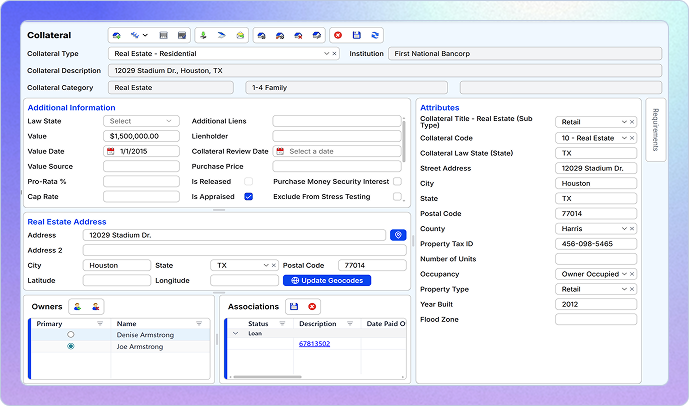
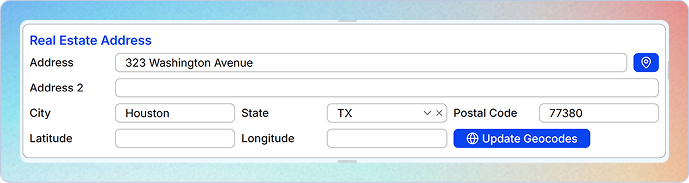
Integrated solutions also support compliance efforts, such as identifying and tracking HVCRE loans, while simplifying repetitive tasks like geocoding and collateral mapping.
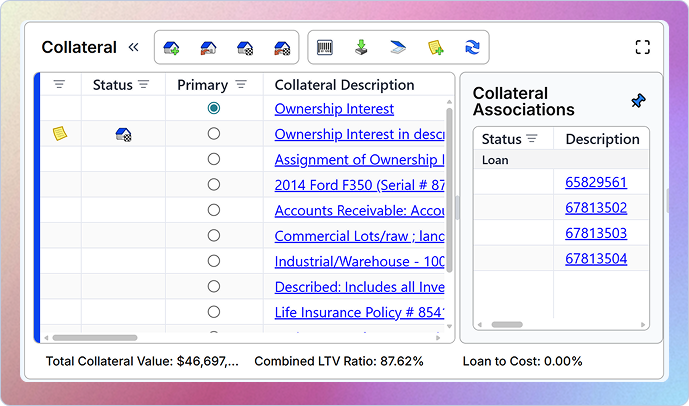
The result is a more efficient, centralized approach to collateral management that reduces manual work and improves visibility.

Automate: Collateral Tracking and Collateral Analysis Software to Improve Efficiency
A strong collateral management system should deliver accurate LTV and LTC calculations- even across complex, cross-collateralized relationships- while making results easily accessible within customer records and reports.
Automation also eliminates manual reporting processes by generating and distributing custom reports automatically, reducing reliance on spreadsheets and emails.
Integrated exception tracking and document management ensure collateral requirements are continuously monitored. The system can track items like insurance and UCC filings, notify staff of expirations or required actions, update management reports in real time, and even notify customers when documentation is needed.

Minimize Risk: Granular and Customizable Oversight for Management
A flexible collateral management system should allow you to track concentrations of credit across standard metrics like NAICS codes as well as custom-defined attributes unique to your institution. This level of granularity enables you to identify, monitor, and report on shared risk factors- such as common builders, developments, or other portfolio-specific exposures.
Clear visibility into cross-collateralized relationships helps prevent accidental releases and reduces user error by ensuring all pledged collateral is accurately tracked and presented.
INFO-ACCESS also supports customizable data collection, allowing your institution to define, capture, and immediately report on new risk factors- without relying on manual processes or system enhancements.
In summary
Gain Control Over Collateral Risk
Effective collateral risk management requires more than manual processes and disconnected systems. From tracking collateral documentation and monitoring inspections to managing concentrations and ensuring compliance, financial institutions need a centralized approach to maintain control and reduce risk.
INFO-ACCESS brings these functions together by integrating collateral data, document imaging, and exception tracking into a single platform. With automated LTV and LTC calculations, real-time tracking of insurance and UCC filings, centralized inspection management, concentration monitoring, and configurable reporting, your institution can improve accuracy, strengthen compliance, and confidently manage collateral risk.
Other Key Factors to Consider
Discover how INFO-ACCESS helps financial institutions centralize documents, monitor documentation requirements, and improve operational confidence.
Ready to Explore Partnership?
Connect with a specialist to learn more about INFO-ACCESS and how we can best tailor it for your institution’s needs. We walk alongside you with hands-on guidance every step of the way.