
Intelligent Document Management
the Key to Operational Success for Financial Institutions
FOR WHO
Banks & Credit Unions
WHY IT MATTERS
Reduce documentation hassle and risk, and strengthen audit readiness.
WHAT YOU'LL LEARN
What a modern DMS should do, why choose an ECM, and how INFO-ACCESS adds an intelligent layer of monitoring and control.
KEY OUTCOMES
• Faster retrieval
• Fewer exceptions
• Stronger compliance
• Real-time visibility
Document Operations With INFO-ACCESS
Financial institutions operate in a documentation-driven environment. Critical records cannot be scattered across folders, drives, or disconnected systems.
Every loan, deposit account, and customer relationship generates documentation that must be properly managed and accessible.
In an unstructured system, financial institutions experience the following challenges:
Missing or incomplete loan documentation
Difficulty locating customer records quickly
Manual tracking of document exceptions
Increased regulatory risk during audits
Time wasted searching across multiple systems
A modern Document Management System (DMS) solves these problems by centralizing documents and connecting them directly to customer relationships.
What is a document management system?
A Document Management System (DMS) is software that stores, organizes, indexes, and retrieves institutional documents electronically.
With a DMS, Critical Records are:
Properly indexed
Securely stored
Continuously monitored
Audit and examination ready
Easily retrievable
Instead of relying on paper files or disconnected storage systems, a DMS allows your institution to manage documentation in a structured and searchable environment.
A strong DMS should allow institutions to:
• Digitally store and organize documents
• Index documents with searchable metadata
• Quickly retrieve files tied to customer records
• Maintain version control and audit history
• Enforce document retention policies
• Improve operational efficiency across departments
Key Limitations of a Traditional DMS
1
Disorganized Document Management Practices
All too often, document management systems at banks and credit unions are not well organized. When users fail to properly name or separate documents due to lack of understanding or time constraints, further workflow efficiencies are lost due to the poor structuring.
Some of these efficiencies lost include:
Inability to Reuse Documents for New Accounts and Loans
It’s difficult to find and reuse previously collected documents due to poor organization and sub-par keyword application.
Consequence: Damaged customer confidence in your ability to keep up with their documents.
Disconnected Document Archival & Exception Tracking
Documents are imaged for long-term storage, but exceptions are not accurately removed from reporting.
Consequence: The burden of tracking is put on your team, leading to mistakes, lost exceptions, and slower workflows.
Poor Following of Document Retention Rules
Keywords and organization habits don’t allow for safe and accurate retention policies to be applied and executed.
Consequence: Added risk, since failure to purge old documents means that you are still legally liable to produce them upon request, which is a time-consuming task.
The documents you collect are a living part of your portfolio management. If your DMS is simply a digital archive then you’ll be relying on the power of personnel to evaluate, track, and maintain loan and deposit files. But manual tracking is time-consuming and prone to error.
2
Limited Automation and Operational Efficiency
Another common problem is the DMS solely acting as a digital storage archive, failing to address the operational realities and complex processes of banking.
Financial institutions must also manage:
• Loan documentation requirements
• Collateral documentation
• Compliance verification
• Customer-centric document relationships
You need additional support and functionality for you DMS, one that automates tasks and simplifies workflows- doing more of the work for you.
3
No Built-In Tools to Reduce Manual Work
Four Critical Needs of a Financial Institution’s DMS
Documents Tied to Customer Record
Documents should be organized around the customer relationship, not scattered by document type.
This allows bankers to quickly view all documents tied to a customer—including loans, deposits, collateral, and notices.
Real-Time Document Visibility
Staff should be able to instantly see:
• What documents exist
• What documents are missing
• What items require follow-up
Without this visibility, documentation issues often surface too late.
Integration With Core Banking Systems
A DMS should connect to your existing systems so that documents remain aligned with customer data, account information, and institutional records.
Automated Monitoring & Exception Tracking
Financial institutions need tools that automatically monitor documentation requirements and highlight missing items- freeing staff for other tasks.
Unfortunately, most document management systems do not provide any or all of these needs.
A Note on Loan and Deposit Origination Systems
Loan and deposit origination systems are designed to collect data and generate documents—not manage them long term. Without integration with a document management system, institutions often end up duplicating work as documents move from origination into archival, tracking, and exception management processes.
Transform Document Management with an Integrated ECM
Your DMS is a critical component of enterprise content management, but on its own it cannot deliver the full functionality your institution needs without integration with an enterprise content management (ECM) system.
An enterprise content management (ECM) system is a centralized platform that manages documents and information in a structured, searchable, and secure way. Unlike a basic document management system (DMS), an ECM integrates with your DMS and core data while adding capabilities such as document imaging, exception tracking, collateral management, events and notes, custom customer notices, document sharing, and more.
When your DMS and ECM are integrated, your systems—not employees—monitor your documents.
With this level of automation, your team no longer spends time evaluating documents, updating spreadsheets, or producing manual reports. Instead, your institution gains functionality far beyond simple document storage and organization.
Transform Document Management with an Integrated ECM
INFO-ACCESS (IA) is an ECM that builds on the foundation of traditional document management by adding an intelligent layer designed specifically for financial institutions. IA provides thorough functionality to your DMS, integrating seamlessly with your core and all ancillary systems.
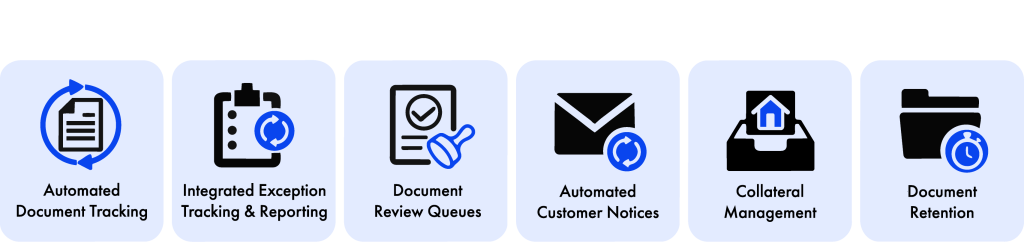
With INFO-ACCESS, institutions:
• Centralize all customer documentation
• Automated monitoring of documentation requirements
• Track exceptions in real time
• Maintain regulatory compliance
• Provide staff with immediate visibility into documentation status
This ensures documentation integrity across your institution while reducing the operational burden on staff.
Drive Efficiency With INFO-ACCESS, An Integrated ECM
Properly managed, sophisticated document management systems built to serve as true enterprise content management systems improve your institution’s efficiency ratio, making a direct impact on your bottom line.
With INFO-ACCESS, your institution can connect your workflows from document management to exception tracking to customer notices to document retention, so your employees spend less time shuffling documents and matching up siloed systems or disparate tracking spreadsheets.
Your employees will find that the DMS is more accurate, easier to use, and a benefit to their day as they are freed up for other tasks, reporting will be more timely and accurately, and tensions between departments will diffuse as your no longer searching for those documents that are “in the mail”.
Key Takeaway
Add more to your document management functionality with INFO-ACCESS, an ECM that integrates with your DMS, providing your institution with an abundance of added functionality that will set your teams up for operational success, audit readiness, and positive customer feedback.
Other Key Factors to Consider
Discover how INFO-ACCESS helps financial institutions centralize documents, monitor documentation requirements, and improve operational confidence.
Ready to Explore Partnership?
Connect with a specialist to learn more about INFO-ACCESS and how we can best tailor it for your institution’s needs. We walk alongside you with hands-on guidance every step of the way.